
The short answer
If your furnace is old, needs frequent repairs, or has a safety problem like a cracked heat exchanger, replacement usually makes more sense than another fix. We inspect the whole system, including ductwork, venting, gas, and electrical, then lay out repair, gas furnace, and heat pump options so you can choose based on your home and budget.
A furnace doesn't get much attention in the Santa Clara Valley until a cold, damp January morning when it won't light. Winters here are mild compared to much of the country, so many homes run older furnaces that sit idle for months and then work hard for a few weeks. When yours starts failing, you have more choices than you might expect: repair it, replace it with a new gas furnace, or switch to a heat pump. ComfortFlow HVAC Contractor installs and replaces heating systems for homeowners in San Jose, Santa Clara, Campbell, Milpitas, Cupertino, and surrounding areas. This page explains how to tell when it's time, what we look at, how to weigh your options, and what to expect when we come out.
Signs You May Need a New Furnace
Some problems are simple repairs. Others point to a furnace near the end of its useful life. These signs suggest it's worth getting a replacement assessment:
- The furnace is old and repairs are becoming a yearly event.
- Some rooms stay cold while others get too warm, even after filters and vents are checked.
- The burner flame looks yellow or flickers instead of burning steady blue.
- Your carbon monoxide alarm has gone off, or a technician found a crack or corrosion in the heat exchanger.
- You hear banging, rattling, or screeching when the system starts or runs.
- Gas or electric bills are climbing without a change in how you use the heat.
- The furnace short-cycles, turning on and off frequently without warming the house.
- Rust, soot, or water is collecting around the unit or the vent pipe.
What We Check Before Recommending Anything
A furnace is only one part of a heating system. Putting a new unit on old, leaky ducts or an undersized vent can cancel out much of the benefit. Before we recommend a repair or a replacement, we look at the full picture.
We also ask how you use your home: which rooms feel uncomfortable, whether anyone works from home, and whether you're thinking about adding cooling. Many homes in the hotter southern and inland parts of the valley benefit from planning heating and cooling together.
- Heat exchanger condition and signs of cracks, rust, or overheating
- Burners, ignition, flame sensor, and safety controls
- Blower motor, belts, and airflow across the system
- Venting and flue, including proper slope, clearances, and draft
- Gas line sizing and shutoff, or electrical panel capacity if a heat pump is an option
- Ductwork for leaks, crushed runs, poor insulation, and undersized returns
- Thermostat location, wiring, and compatibility
- Size of the home, insulation, windows, and sun exposure, so equipment is sized correctly
Repair, Replace, or Switch to a Heat Pump
Repair makes sense when the furnace is in reasonable shape, the problem is a single part like an igniter or blower motor, and there are no safety concerns. We'll tell you plainly if a repair is the sensible choice.
Replacing with a new gas furnace is usually the right call when the heat exchanger is damaged, repairs are frequent, or parts are hard to find. Higher-efficiency models use less fuel, and variable-speed blowers can even out temperatures from room to room.
A heat pump is worth serious consideration in our climate. Santa Clara Valley winters are mild and damp, which suits heat pump heating, and a heat pump also provides air conditioning for hot summers. Some homeowners pair a heat pump with an existing or new furnace as a backup.
Local rules matter here too. Under Bay Area Air District rules, natural gas furnaces manufactured starting in 2029 must meet a zero-NOx standard, which in practice points homeowners toward heat pumps for replacements after that date. These rules do not force you to replace working equipment; they apply only when a furnace fails or is replaced. If your furnace is aging, it's reasonable to factor this into a decision you'll be living with for many years.
What Affects the Cost of Furnace Installation
Every home is different, so we quote after seeing the system. These are the factors that tend to move the price up or down:
- Type of system: gas furnace, heat pump, or a dual-fuel combination
- Equipment size and efficiency level
- Single-stage, two-stage, or variable-speed operation
- Condition of the ductwork and whether sections need sealing, repair, or replacement
- Venting changes, such as switching to the PVC venting high-efficiency furnaces require
- Gas line or electrical panel upgrades
- Location of the unit, such as an attic, crawlspace, closet, or garage, and how easy it is to reach
- Permits and inspections required by your city
- Add-ons like a new thermostat, air filtration, or a matching air conditioner
How a Furnace Installation Visit Works
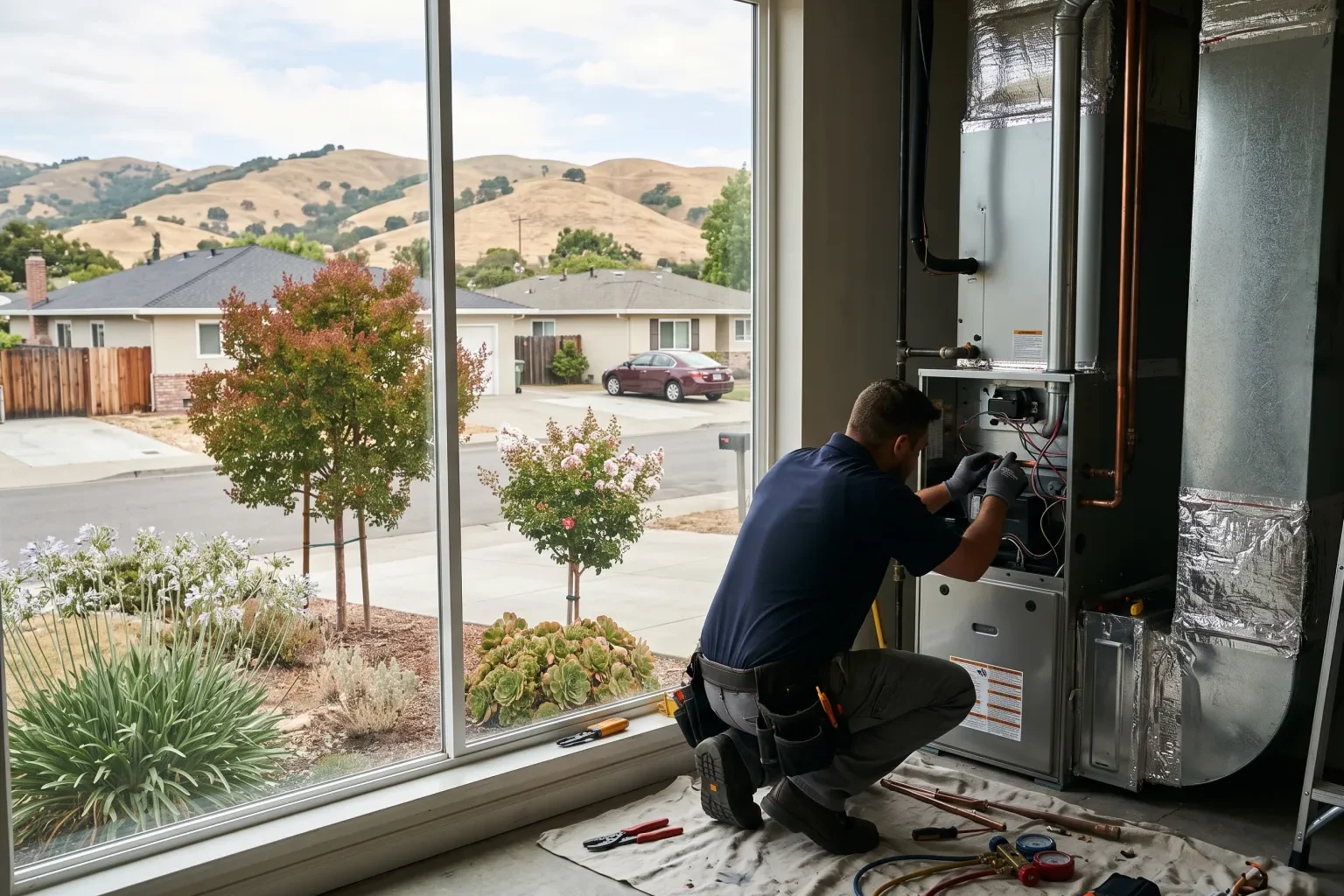
First, we schedule an in-home assessment. A technician inspects your current system, measures the home, and talks through comfort problems and goals. If there's an immediate safety issue, we'll explain it and help you make the home safe.
Next, we give you written options. Typically that means a repair path if it's realistic, one or more furnace options, and a heat pump option where it fits. We explain the trade-offs in plain terms and check current incentives through BayREN and your local clean energy provider, since amounts and availability change by funding cycle. Note that the federal 25C tax credit for heat pumps ended for installations after December 31, 2025.
On installation day, we protect floors and work areas, remove the old equipment, set the new unit, connect gas or electrical, update venting and ductwork as needed, and install or configure the thermostat. Most straightforward replacements are completed in a day; jobs involving duct or electrical work can take longer.
Finally, we test the system, check for safe combustion and proper airflow, walk you through operation and filter changes, and coordinate any required city inspection.