
The short answer
Call for furnace repair if your system blows cool air, shuts off and restarts repeatedly, makes new noises, or shows an error light. We test the full heating sequence and explain the cause and price before any work begins. We also help you decide between repair and replacement under current Bay Area rules.
Santa Clara Valley winters are mild and damp rather than harsh. Many San Jose furnaces sit idle for months, then have to work hard on the first cold nights of the season. That on-and-off pattern is often when weak igniters, dirty flame sensors, and clogged filters start causing trouble. ComfortFlow HVAC Contractor repairs gas furnaces in homes across San Jose and nearby cities, including Santa Clara, Sunnyvale, Campbell, Milpitas, and Cupertino. This page covers the warning signs, what our technicians check, how to think about repair versus replacement, and what to expect when we come out.
Signs Your Furnace Needs Repair
Some furnace problems are obvious, like no heat at all. Others build slowly and are easy to ignore until the system stops on a cold evening. Schedule service if you notice any of the following:
If you smell gas, leave the house, avoid flipping switches, and call your gas utility or 911 from outside. If a carbon monoxide alarm sounds, get everyone outside and call emergency services first. Book a furnace repair visit only after the home is safe.
- The furnace runs but blows cool or lukewarm air
- It starts, runs for a few minutes, shuts off, and then restarts (short cycling)
- Rooms heat unevenly, or some vents barely move air
- New noises, such as banging at startup, squealing, rattling, or loud humming
- A burning smell that lasts beyond the first few runs of the season, or any smell of gas
- A burner flame that looks yellow or flickers instead of burning steady blue
- A blinking error light on the control board
- Heating bills rising even though you use the system the same way
What We Check During a Furnace Repair Visit
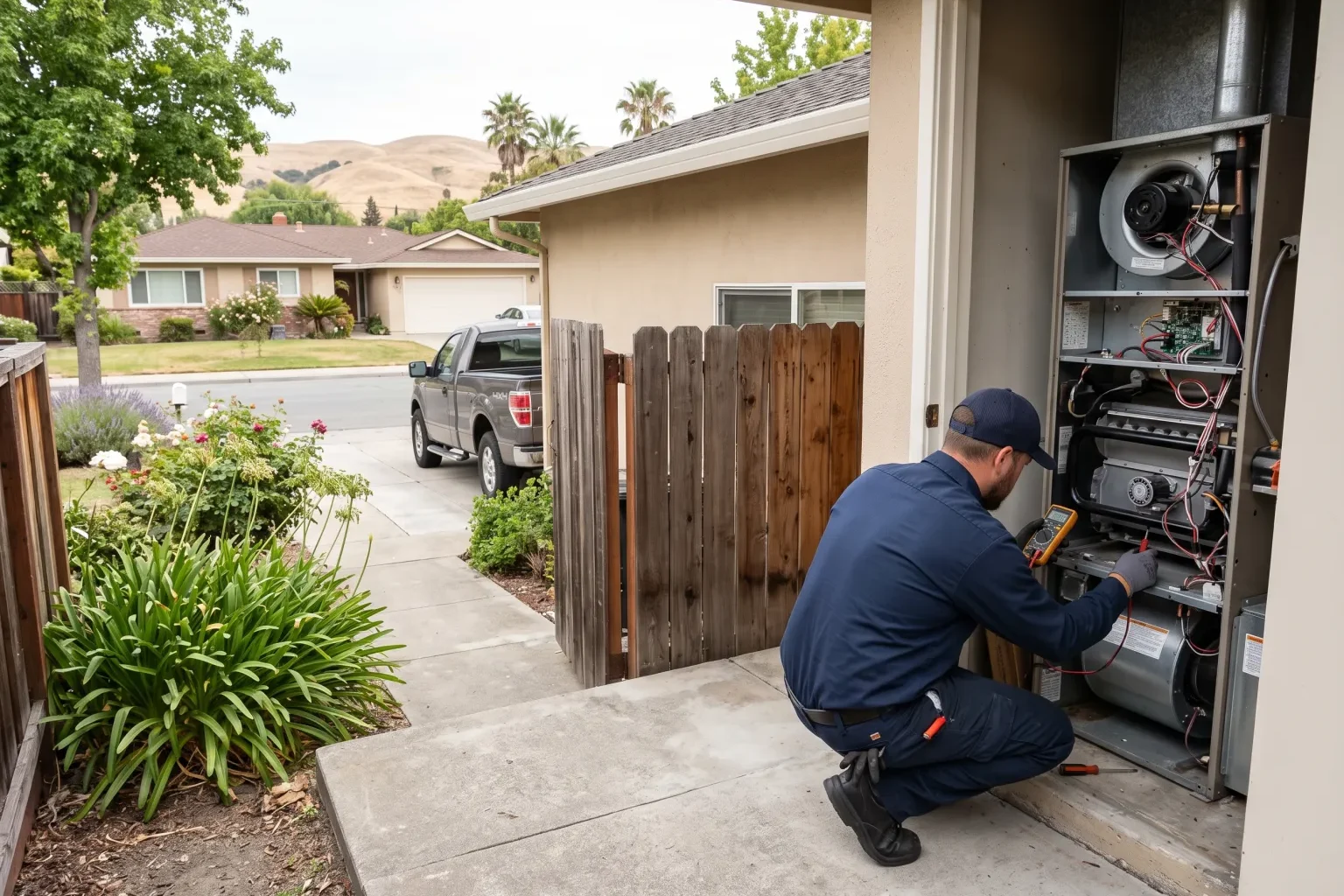
A furnace works through a chain of steps. The thermostat calls for heat, the inducer fan clears the exhaust path, the igniter lights the burners, the flame sensor confirms the flame, and the blower moves warm air through the ducts. A failure anywhere in that chain can stop the whole system, so we test each step in order instead of guessing at parts.
When conditions call for it, we also take a carbon monoxide reading around the furnace and near the flue. Once we find the cause, we show you the failed part or the reading and explain what it means. We also tell you about anything else we noticed that may need attention later.
- Thermostat wiring, settings, and batteries
- Air filter condition and the return air path
- Igniter or pilot assembly and flame sensor
- Gas valve operation and burner flame
- Inducer motor, pressure switch, and venting
- Blower motor, capacitor, and belt where applicable
- Limit switches and other safety controls
- Heat exchanger, visually checked for cracks or corrosion where accessible
- Condensate drain and trap on high-efficiency furnaces
- Error codes stored on the control board
Repair or Replace: Weighing Your Options
Most furnace calls end in a repair. Igniters, flame sensors, capacitors, pressure switches, and blower motors are common fixes that can put an otherwise sound furnace back in service. Replacement is worth discussing when the heat exchanger is cracked, when an older furnace keeps needing major repairs, or when parts are no longer available.
Local rules also shape the decision. Under Bay Area Air District Rule 9-4, natural gas furnaces manufactured from 2029 on must meet a zero-NOx emission standard. In practice, that points homeowners toward heat pumps when they replace a furnace after that date. These rules do not require you to replace a furnace that works. They apply only when equipment fails or is replaced. Repairing a working furnace is still a reasonable choice, and it gives you time to plan your next system on your own schedule.
If you are considering a heat pump, the federal Energy Efficient Home Improvement Credit (25C) only covered qualifying heat pumps placed in service before December 31, 2025. It is not available for new installations. BayREN and your local clean energy provider may offer heat pump or electrification incentives, but amounts and availability change by funding cycle. We confirm the current offer before including it in any quote.
Either way, we give you a clear recommendation and the reasons behind it. The decision is yours.
What Affects the Cost of Furnace Repair
We quote after diagnosis, once we know what failed. These factors drive the cost of a furnace repair:
You see the price and approve it before any repair work begins.
- The part that failed: cleaning a flame sensor is a much smaller job than replacing a blower motor or control board
- Whether the part is universal or specific to your furnace's brand and model
- Furnace type and age, since older units may have hard-to-find parts
- Access, since attic, crawlspace, garage, and closet installations take different amounts of time
- Whether more than one component failed, or the first failure damaged another part
- Timing, such as after-hours or weekend service if you need it
How a Furnace Repair Visit Works
Before we arrive, clear a path to the furnace and keep pets in another room. You can also check that the thermostat is set to heat and that the filter isn't clogged. Sometimes that alone solves the problem.
- Scheduling: tell us what the furnace is doing, any error codes or sounds, and where it is installed so the technician can bring likely parts
- Arrival and diagnosis: the technician talks with you about the problem, then tests the system step by step
- Explanation and options: you get the cause, your repair options, and the price before any work starts
- Repair: with your approval, we make the repair, often on the same visit if the part is on the truck
- Testing: we run the furnace through full heating cycles and check its safety controls before we leave
- Wrap-up: we review what we did and point out anything to watch for
Furnace Repair by city
- Furnace Repair in Milpitas
- Furnace Repair in Campbell
- Furnace Repair in Santa Clara
- Furnace Repair in Los Gatos
- Furnace Repair in Monte Sereno
- Furnace Repair in Saratoga
- Furnace Repair in Sunnyvale
- Furnace Repair in Fremont
- Furnace Repair in Cupertino
- Furnace Repair in Morgan Hill
- Furnace Repair in Mountain View
- Furnace Repair in Los Altos