
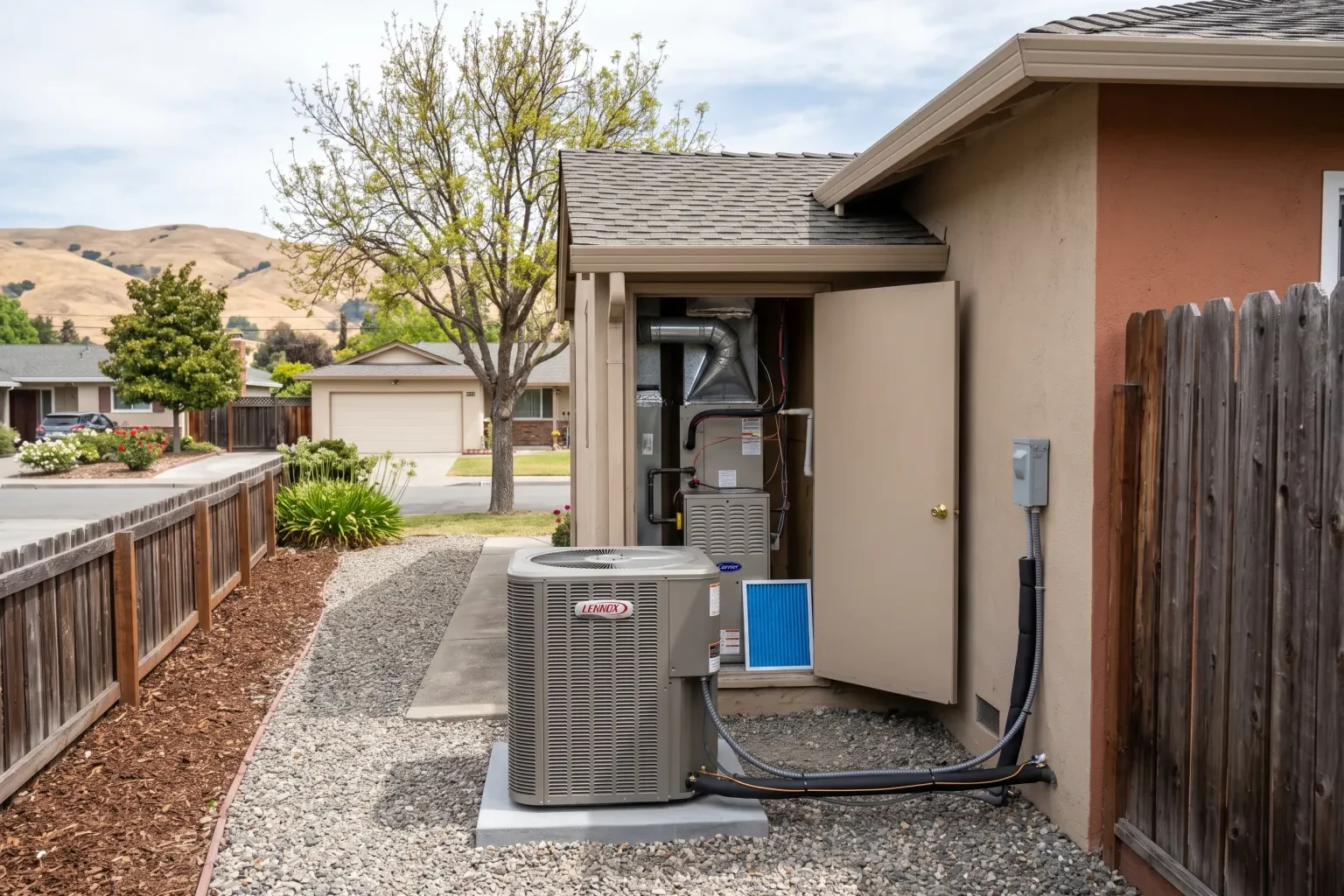
The short answer
If your furnace or heat pump is blowing cool air, cycling on and off, making new noises, or not starting at all, it likely needs a diagnostic visit and repair. ComfortFlow HVAC Contractor serves San Jose and nearby cities. We find the cause, explain your repair and replacement options in plain terms, and get your approval before doing any work.
San Jose winters are mild compared with much of the country, but the Santa Clara Valley's damp, chilly nights still make a working heater important from late fall into spring. Many systems sit idle through our long, dry summers, so problems often show up during the first cold week of the season. ComfortFlow HVAC Contractor repairs gas furnaces and heat pumps, along with the thermostats and ductwork that connect to them, for homeowners in San Jose and nearby cities like Santa Clara, Campbell, Sunnyvale, and Milpitas. This page covers the warning signs to watch for, what our technicians check, how we approach repair versus replacement, what affects the cost, and what to expect when we come out.
Signs Your Heating System Needs Repair
Heating problems rarely appear all at once. Most systems give some warning before they stop working, and catching those signs early usually means a simpler fix. Pay attention the first few times you turn the heat on each fall. That is when worn parts and dust buildup from the off-season tend to show themselves.
Call for service if you notice any of the following:
- The system runs but blows cool or lukewarm air.
- The heater turns on and off in short bursts instead of running full cycles.
- Some rooms stay cold while others are comfortable.
- New sounds like banging, scraping, squealing, or rattling when the system starts or runs.
- A burning or electrical smell that lasts more than the first few minutes of the season.
- The thermostat is set to heat but nothing happens, or the blower runs nonstop.
- A heat pump that ices up and doesn't clear, or that relies heavily on backup heat.
- Your energy bills rise noticeably without a change in how you use the heat.
What We Check During a Heating Repair Visit
Our goal is to find the actual cause, not just the symptom. A furnace that shuts off early, for example, could have a dirty flame sensor, a clogged filter causing overheating, or a failing control board. Each of those calls for a different fix.
Depending on your equipment, a typical diagnostic includes:
- Thermostat settings, wiring, and power supply.
- Air filter condition and airflow through the system.
- Ignition system, flame sensor, and burners on gas furnaces.
- Heat exchanger visual inspection for cracks or corrosion where accessible.
- Venting and flue connections to confirm exhaust is leaving the home properly.
- Blower motor, capacitor, and belts or bearings.
- Safety switches, including limit and pressure switches.
- Refrigerant circuit, outdoor coil, reversing valve, and defrost controls on heat pumps.
- Accessible ductwork for disconnected sections or major leaks.
Repair or Replace: How We Help You Decide
Most heating problems are repairable, and we will tell you when a repair makes sense. Replacement becomes worth considering when a system needs a major component like a heat exchanger or compressor, has needed repeated repairs, or no longer keeps the house comfortable even when it is working correctly. We lay out both paths and let you choose.
Bay Area homeowners should know about the local appliance rules. Under the Bay Area Air District's rules, natural gas furnaces manufactured from 2029 onward must meet a zero-NOx emission standard. In practice, that points homeowners toward heat pumps when a furnace is replaced after that date. These rules do not require you to replace working equipment. They apply only when an existing furnace fails or is replaced. If your furnace can be repaired reliably, repairing it is still a valid choice.
If you are considering a heat pump, check BayREN and your local clean energy provider for current electrification incentives. Amounts and availability change by funding cycle, so we confirm the current offer before including it in any quote. Note that the federal Energy Efficient Home Improvement Credit only covered qualifying heat pumps placed in service before December 31, 2025, so it is not available for new installations now.
What Affects the Cost of a Heating Repair
Every repair is different, so we give you a specific quote after diagnosing the problem rather than guessing over the phone. The main factors that affect what a repair costs include:
- The part that failed. A flame sensor or capacitor is a much smaller job than a blower motor or control board.
- Equipment type and brand, since some parts are more available than others.
- Where the system is located. Attic, crawlspace, and tight closet installations take more time to work in.
- Whether more than one problem is found once the system is opened up.
- The age of the system and whether replacement parts are still made for it.
- Timing, such as urgent visits during the first cold snap when demand is highest.
How a Heating Repair Visit Works
We try to keep the process simple and predictable, so you know what is happening at each step.
First, you contact us and describe what the system is doing. We schedule a visit and give you an arrival window. When the technician arrives, they will ask what you have noticed, then inspect and test the system. Once they find the cause, they explain it in plain language, show you the problem part when possible, and give you your options with a clear quote. No work begins until you approve it. Many common repairs can be finished the same visit if the part is on the truck. If a part needs to be ordered, we will tell you the expected timing and help you stay as comfortable as possible in the meantime.
Before leaving, the technician runs the system through a full heating cycle to confirm it is working correctly and answers any questions you have.
Heating Repair by city
- Heating Repair in Milpitas
- Heating Repair in Campbell
- Heating Repair in Santa Clara
- Heating Repair in Los Gatos
- Heating Repair in Monte Sereno
- Heating Repair in Saratoga
- Heating Repair in Sunnyvale
- Heating Repair in Fremont
- Heating Repair in Cupertino
- Heating Repair in Morgan Hill
- Heating Repair in Mountain View
- Heating Repair in Los Altos